Strabismus

We correct eye alignment problems in boys and girls with strabismus treatment that achieves optimal alignment of the eyes. Our team of strabismus and pediatric ophthalmology specialists is experienced in working with children and builds a friendly, educational relationship that improves children’s attitude toward treatment or surgery and its effectiveness.

What is strabismus?

Strabismus is the condition of altered vision in which parallelism and coordination between the two eyes are lost. It is also known as squint.

A person with strabismus cannot point both eyes in the same direction, so they suffer problems resulting from this condition, such as difficulty making synchronized or coordinated movements. Binocular vision is also impaired, they have trouble judging distances, and they may develop muscle problems due to abnormal head and neck movements made in an attempt to focus their vision.

There are different types of strabismus: muscular, accommodative or mixed strabismus.

The causes of strabismus vary. Among the most common are family history, congenital disorders affecting brain function, brain overload due to illness, optical defects such as hyperopia or astigmatism, large differences in prescription between one eye and the other, or disorders of the muscles and nerves.

Strabismus in childhood occurs in one in every twenty-five children and can be congenital (present at birth) or develop during childhood.

In cases of childhood strabismus, a timely diagnosis is necessary to determine what is causing the eye problem and correct it promptly and effectively, as well as to prevent it from progressing unfavorably for the child. Untreated strabismus in childhood can cause serious problems such as loss of vision and amblyopia, or lazy eye, which may even become permanent.

The early diagnosis and treatment of strabismus allows for more effective treatment and the prevention of vision problems such as amblyopia.

There are different types of strabismus depending on the direction of the deviated eye:

  • Convergent strabismus. The affected eye turns inward. It is the most common type of strabismus in childhood.
  • Divergent strabismus. The affected eye turns outward.
  • Vertical strabismus. The affected eye is deviated upward or downward. It is sometimes associated with convergent strabismus.

At Instituto de Oftalmología Castanera we have a team of professionals specialized in pediatric ophthalmology and in the treatment of childhood strabismus. We have advanced technology and child-friendly facilities.

We create the right environment and offer the close, personal care needed for our young patients to feel at ease, open to the examination and with a good attitude toward treatment, which improves their well-being and the results achieved.

Schedule a strabismus consultation. Prompt action by parents makes early diagnosis and treatment of childhood strabismus possible, which is key to preventing the condition from progressing and causing permanent vision problems.

What is the treatment?

The treatment of strabismus is determined by its cause. Depending on the cause, there is an appropriate ophthalmological treatment to resolve it.

  • Prescription of glasses for strabismus caused by refractive errors.
  • Pediatric ophthalmology surgery for strabismus, strengthening or weakening the affected extraocular muscles.
  • Strabismus surgery combined with prescription glasses, the combined treatment that some patients require.
  • When strabismus has already led to amblyopia, or lazy eye, both conditions must be treated together.

Strabismus should be corrected early to prevent amblyopia from developing, since after the age of 9 it can become permanent. Ideally, in young children with strabismus, treatment should be applied before the age of six. That is why it is so important for parents to act promptly and seek professional help that allows children to be diagnosed and treated quickly.

Schedule a first consultation with our strabismus specialists. The pediatric ophthalmology team at Instituto de Oftalmología Castanera will see you with the professional and personal care that sets us apart.

Our specialists talk about strabismus

What is strabismus?
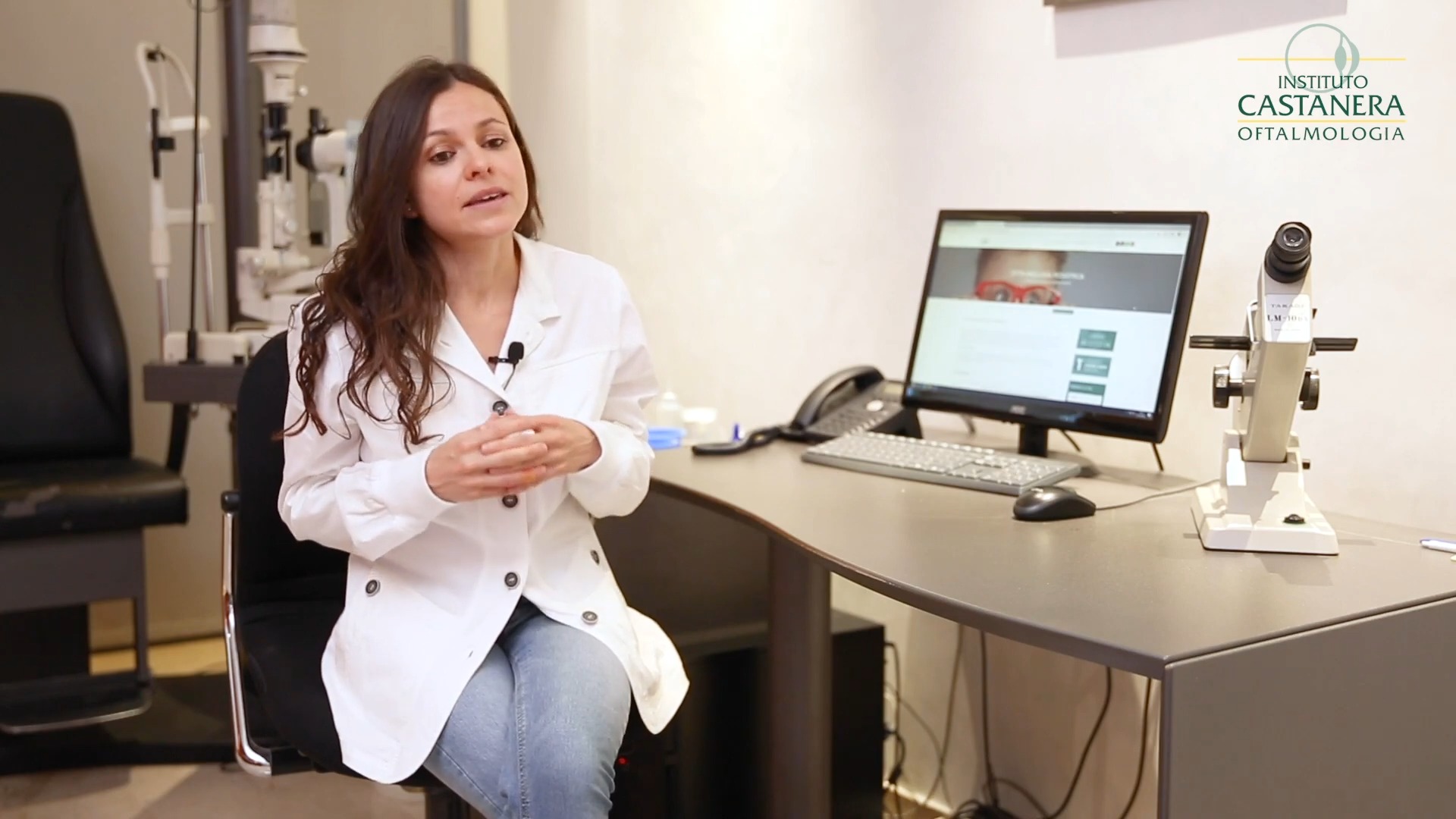
What is strabismus? Dr. Gemma Romeu, a specialist in pediatric eye disorders and neuro-ophthalmology at Instituto de Oftalmología Castanera, explains it in this video.
Ophthalmology – Electronic device screens: are they harmful to children?
Dr. Alicia Serra Castanera of Instituto de Oftalmología Castanera explains the effects of screen use on children, offering recommendations to protect their visual health and prevent eye problems.
Strabismus in children
What is strabismus? What types are there? How can it be treated? Dr. Gemma Romeu, a specialist in pediatric ophthalmology, answers all these questions.
Pediatric ophthalmology
When should we take little ones to the ophthalmologist? Why is it important to do so? What is lazy eye? What are its causes? Dr. Gemma Romeu, a specialist in pediatric ophthalmology, answers all these questions.

Professionals who form the medical team for strabismus

Medical license no.: 23816 COMB

Dr. Alicia Serra Castanera

Medical license no.: 43275 COMB

Dr. Gemma Romeu Cerrillo

Medical license no.: 23816 COMB

Dr. Alicia Serra Castanera

Graduated in Medicine and Surgery from the UAB in 1986, specialist in Ophthalmology. Her work at Instituto Castanera focuses on the medical and surgical diagnosis and treatment of pediatric eye disorders, as well as the treatment of strabismus in both children and adults. She takes part in numerous courses, congresses and scientific meetings, as well as in a clinical research trial on the efficacy of different drugs for the treatment of pediatric glaucoma, and in the “RTOC” (Pediatric Ophthalmology Telemedicine Network of Catalonia), aimed at improving the diagnosis and treatment of retinopathy of prematurity.

Medical Societies:

  • Catalan Society of Ophthalmology, board member, Vice President
  • Spanish Society of Ophthalmology (S.E.O)
  • Spanish Society of Strabology (S.E.E)
  • Spanish Glaucoma Society (S.E.G)
  • European Paediatric Ophthalmological Society (E.P.O.S), board member

Medical license no.: 43275 COMB

Dr. Gemma Romeu Cerrillo

Graduated in Medicine and Surgery from the University of Barcelona in 2007. Specialist in Ophthalmology.

Master’s degree in Pediatric Ophthalmology at Hospital Sant Joan de Déu (University of Barcelona), where she teaches neuro-ophthalmology.

Her work at Instituto de Oftalmología Castanera focuses on the medical and surgical diagnosis and treatment of pediatric eye disorders, the treatment of strabismus in children and adults, and neuro-ophthalmology.

Medical societies:

  • Catalan Society of Ophthalmology
  • Spanish Society of Strabology (S.E.E)

Frequently asked questions

Yes. Even if the squint is obvious, it is necessary to determine the causes of the strabismus in order to correct and resolve the problem effectively. To do this, and at the specialist’s discretion, a complete eye examination may be required, including a detailed study of the internal parts of the eye.

When the appropriate treatment is applied to correct it, according to the needs of each case. There is a mistaken belief that strabismus goes away on its own. This is not the case, except in very young babies whose misaligned gaze is due to a lack of focus. To prevent poor progression and permanent damage to vision, specialists recommend early diagnosis and treatment.

The price of surgery to correct strabismus in childhood depends on different factors, such as the quality and up-to-dateness of the equipment and technology used, the training and experience of the professional team and the follow-up, among others. Schedule a consultation to receive a personalized quote if the evaluation and diagnosis recommend surgery to correct the strabismus.

In those cases where surgery is unnecessary and the eye deviation can be corrected by prescribing and wearing glasses.

It is a simple postoperative period, and after one or two days the child can resume their daily activities. The eye may be red for several days, and in some cases mild discomfort and swelling around the eye appear during the first few days, which go away on their own. 

Phone:

+34 932 173 704

Language: